Tammer in Philly wrote:A perfect example of the effect of religious belief on the misguided and weak of mind. Here, it provides a convenient front for the obvious bigotry of the individual (cf his earlier emails regarding the President's wife):
http://www.dailymail.co.uk/news/article ... ident.html
-tammer
I wanted to respond one more time because I feel genuinely bad about what I think is misunderstanding and I don't want it to lead to hard feelings. I think you’re a good guy, and I don’t think you or anyone else is a bigot of any sort, but bear with me a few minutes while I try to sort through why you got the response from me that you did. And please bear in mind I am not trying to convince you to change your beliefs in any sense, I am just trying to urge you to give a little space to others, and I think / hope the specifics of that will be clear shortly.The point here is not to debate with you further, or more importantly to argue, but rather to give you a better sense of what is behind my statements so that you understand it is not motivated by any personal animus.
That intro aside, to your main point, I think I understand it and it’s pretty straightforward: that there is abuse of religion and that people who claim to be religious do many screwed up things in the name of religion or God. I also take your point that many of these folks are hypocrites. If that’s the thrust of what you’re saying we don’t disagree.
But here’s the thing, and here’s why I find myself defending people who, for example in the case of creationism, with whom I don’t agree. Remember the point I made about whether a free society means respecting religious differences (or not having a religion) or whether it means essentially banning God? It’s not an academic point, and it’s not about me wanting to make sure that there’s a nativity scene in front of the post office (I don’t care if there is or is not one.) For me, the reason I think it is important NOT to completely ban God is because while it is like shooting fish in a barrel to point out how all the great religious faiths have been abused by lunatics throughout the centuries -- Islam is now only the latest, look at Christianity during the Crusades and the Middle Ages -- it is also important from a legal philosophy perspective to have a God, because in my view (and I understand you may disagree) it provides the lynchpin of having a just society -- a society that respects life, a society that helps the less fortunate, a society that is essentially decent.
To better illustrate what I mean here, it is only necessary to survey the history of the 20th century. Look at the barbarity and atrocities committed by the worst regimes of the last 100 or so years: the Soviets, the Nazis, etc. Look at some of the horrific things that go on in communist China, particularly with respect to the child-bearing policies. Look at North Korea. Look at Iraq -- if Hussein were actually a real Muslim instead of a nationalist using religion to advance his agenda he would never have committed the atrociities that he did. The point is that I think it is fairly non-controversial to say that these regimes were engaged in the worst human rights abuses in recent memory -- basically a complete lack of respect for human life, which is essentially the underpinning of all law -- and what do all of them share in common? The banishment of God and the replacement with the “State” or some supreme leader. The result is predictable and inevitable: human beings are a means to whatever goal the state envisions. Life is not respected, and neither is the dignity of human beings.
Now go back for a minute to your completely legitimate point about religious abuses -- the treatment of women in Saudi Arabia today or by the Taliban. Look at some of the bigotry in our country that you cite -- let’s assume for the sake of argument it is all true. Then let me ask you this: would you rather be a woman today in Saudi Arabia or a solider in 1943 on the front lines of the Red Army? Would you rather be a woman today in Saudi Arabia or a Jew in Nazi Germany? I don’t want to in any sense diminish the legitimacy of your point with respect to the abuses of religion, but I guess my point is we need to try to correct those abuses -- do a better job of having people read Aquinas for starters -- than to simply banish religion and God. Stated differently, and more importantly, the society that has an imperfect or even pretty screwed up view of what God wants (Saudi Arabia, in our example) is a far safer, in terms of its basic respect for human life, than one with no God, or one that refuses to contemplate / acknowledge the existence of God. That’s my first point -- the reason I tend to “stick up” for religiously conservative people is because while in many respects I disagree with them doctrinally, I also think they serve as a useful counterweight / foil to those on the other side who are more dangerous, in my view, because they want to completely ban God from the public square. You may disagree with me on the necessity of a God as a prerequisite for any concept of just or moral law, but I think the historical examples are on my side, in terms of what is the greater / lesser evil.
Second point I want to make is about the appropriateness of religious convictions manifesting themselves in policy preferences and policy debates. A lot of people, perhaps you as well, seem to make the point that, for example, a candidate like Rick Santorum using his religion as a basis to say that rape victims should not be permitted abortions is inappropriate because the person, in this case Santorum, is injecting his religious beliefs inappropriately into a public policy decision. I’ll take your point that, as a practicing Catholic even, I find Santorum’s prescription a tough pill to swallow in this instance.
That being said, I think there is a tendency amongst people on your side of the political spectrum to try to “domesticate” religion and put it up on a shelf somewhere. What I mean by that is that religion is fine when it does not pose policy outcomes counter to the prevailing “enlightened” beliefs of popular society. So, for example, if the Catholic Church teaches us to help the poor, or that the war in Iraq is not appropriate, those teachings are acceptable and non-controversial because they generally gibe with the politics of Jon Stewart and people of his ilk. And the holders of such beliefs are thus not cast as “religious extremists” or “religious fanatics” or another similar descriptive because their beliefs are in keeping with the appopriate dogma.
But if the Catholic Church, and practicing Catholics, oppose something that I think is pretty objectively horrible to most people, say late term abortion, then a candidate stating opposition to such a practice on moral grounds would, based on what I commonly read, be accused of inappropriately injecting religion into the political arena. The point is that you and I, and people similarly situated, have a foundational disagreement about the necessity of a God in order to have a just society and just laws -- to respect the basic liberty of the individual as a free person, in other words. I think that such a nexus is necessary, for me the question is where to draw that line so that people who believe differently can practice, or not practice, as they think appropriate. For you, because you come to the debate from a different perspective, any outward manifestation of religion as a policy preference will for the most part draw the critique that it is inappropriate expression, and, because pointing out imperfection in humans is like, once again, shooting fish in a barrel, draw the critique that the exponent of such a belief is in some fashion a hypocrite, thereby allowing you to diminish the person’s stature, and more importantly the stature of the person’s argument / belief.
The point here is not for me to argue with you for sake of arguing and to convince you I am right -- that’s the fool’s errand because people only come to these things on their own -- but rather to urge you to recognize and respect the fact that because you come to the view of law from a very different perspective than those people who believe in God, that oftentimes if not always you will see any outward manifestation of faith as a policy choice as a suspect, inappropriate manifestation of religion when it contradicts your own views. That’s not befitting someone who is a truly intelligent and liberal, in the sense of classical liberal -- and I believe you to be those things. For people on my side of this divide, the struggle, and it is not an easy one or in any sense a bright line, is to find a way to honor religious traditions but do so in a respectful and liberal -- again in the sense of classical liberal -- manner that respects the views of other non-believers -- to make sure we don't force our faith on people who don't share it.
This isn’t easy stuff, in other words

and given how tough it is we all need to be very judicious and sparing in our criticism of one another. So to the extent I was harsh or ill-tempered, you have my apologies. But at the same time, I would respectfully request you lay off the critiques of religious idiots -- rest assured that those of us on my side see that for what it is.

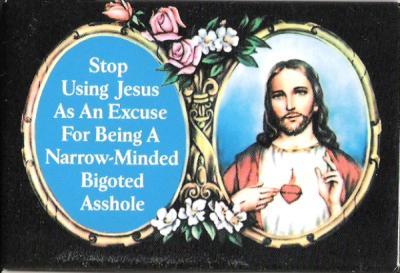


 Ouch!!!