

Those are really just the worst areas. I'm not sure about the subframe mounting areas. The fenders are so-so, doors are good, the metal strip under the back bumper is in pretty rough shape and one of the mounts for the front diving board is straight up FUBAR'd. I'll have to get some pics of all the areas cause I'd really like to fix what can be fixed. As of now all I've done is hit the bad areas with Rustoleum rust reformer.slimdevil27 wrote:Is that the extent of the rust on your E28 or just the worst areas? How are the subframe mounting areas? How are the fenders, doors and other body panels?
Trade 535i for 318i?
-
Tammer in Philly
- Posts: 10719
- Joined: Feb 12, 2006
- Location: CHI, IL
slimdevil27 wrote:
I have no idea what a profile gasket is and most likely neither does the OP
E28-->E36 new tools:Can he fix everything on the the E36 like he can the E28? There's the sticking point, you are adding a whole new skill set and tool set for the diagnostics. Not just any diagnostics but European diagnostics, which not every shop will handle and does not have anywhere near the support as Domestic or Japanese. For something that old, yeah it's there and getting cheaper all the time.
16mm socket, 18mm socket, T20/25/30 Torx bits. That's about it.
Wrong; the E36 in question was a '95 318i. OBD1, no scan tools needed. Single pre-cat O2 sensor, just like an E28. No real electrical diagnostics at all.So what crap was I spouting? That it would need to go to a shop for repairs? Most likely unless he has a scanner/software and the capability to use it. That most general repair shops won't touch euro? I know shops that don't even do ELECTRICAL!
Given how much of your info was misinformed, I'm not sure I was wrong to correct it.Do I have the experience to back up everything I said? Yeah I do. That's what you called me out on and what I took offense to.
-tammer
-
slimdevil27
- Posts: 935
- Joined: Nov 12, 2011
- Location: WA
I have yet to find a car that breaks the laws of physics. When you apply yourself to learn the fundamentals and have a sound understanding of the theory...the application in which that theory is used ceases to matter. Take electrical, if you fully grasp electrical theory does it matter that you are working on the electrical circuit of a Pinto or brand new Porsche? Why is the Briggs & Stratton on my lawn mower the same as a Lamborghini? Because the laws of physics still apply. Would I diagnose a lack of power complaint the same way on a Lamborghini as I would a Pinto? Fundamentally, yes. Although a lack of power at 150 mph might be a bit harder to replicate than one at 50 mph.Albert Einstein must have been a complete moron for not even being able to drive a car while you, on the other hand, are ASE MASTER CERTIFIED to work on all makes and models!
Some geniuses can't even tie their shoe and the reason Albert was a moron was because when he came up with the theory of relativity....he didn't have a PhD. I use zippers.

That is a statement of fact. You want to jump in and take a crack, fine... but the second you get called out....it...ahhh..well...it was a:it took me a whole night to get my ASE certs.
Point taken....dimwit. And I agree, you can knock out most of them in a night. Around here they were splitting the testing into two nights with specific tests and recerts on specific nights...what a waste of time, especially for recerts. The testing center where I used to live did them all day long for any test you needed to take.Figure of speech,
Civil interaction?Seems as though you're just a little fish in a big pond 'round here, and one that's incapable of civil interaction at that as well.
 Someone being offended by a joke I made or a fact stated...is not my problem. If they are offended it's their problem, they can deal with or they can go cry about it in their diary. What are you gonna do kick out every asshole and prick? There'd be no one left. Great, you could turn this into every other whining, watered down forum.
 The complaints you have about ASE testing are shared industry wide. ASE was under pressure from techs and shop owners alike about the testing quality being to lenient, and to general. Shop owners because they wanted a definitive "benchmark" for hiring and upper level techs because how else do you distinguish between a grease monkey and an Automotive Technician? At the same time they needed to expand the A8 Engine Performance test. It was dated and didn't really include modern fuel injection. They tried to kill two birds with one stone with the L1 Advanced Engine Performance test. In order to simulate real world diagnostic testing they came up with a "Composite Vehicle". At the beginning of the test you get the "factory" manual for a fictitious vehicle, complete with sensor values, operational information and wiring diagrams. The question format of "Technician A says "X", Technician B says "Y" is almost completely gone. Instead it asks " At pin 32 of the ECM a DVOM measured .35 volts with the engine running, what is the likely cause?" or it gives a snapshot of scan data values and multiple choice for the most likely cause such as " Open at pin 2 of the ECM", "Short to ground at pin 5 of the ECM" etc. As such there is really no way to study for it and I think it does a fairly good job of simulating the daily "diagnostic dilemmas" we all face. It's more dynamic in the sense that you need to extrapolate from the given data set while drawing on your knowledge of various disciplines such as electrical theory, engine mechanical fundamentals, etc. and apply a sound diagnostic strategy. Hands down it's better than the test format of the A1-8, but really it had to be. In the past 50 years not a whole lot has changed for those tests. HVAC is the same with the only major addition being electronic climate control and recycling, Brakes added 4 wheel ABS, traction and stability control integration, Transmissions- still using and abusing the fluid, adding electronic control and lockup convertors....The same basic systems and operational theory. Besides structural engineering, design and the associated machining and materials advancements, the single largest change has been in the engine/drivetrain performance arena. Part of that is being able to quantify changes through computer modeling, you don't have to build it to know how it will work. Another part is reapplying proven theory now that technology is to the point of it not only being practical for manufacturing, but quantifiable in the gains. Take the Dodge trucks-it switches on the fly between 4, 6, and 8 cylinder operation...the same thing Cadillac tried in their 468 back in the 80's, it worked, but not very well. It was a sound theory but the technology to make it work at that point was not condusive to manufacturing from a cost standpoint. Now though...it's flawless, the only way you know it's dropping cylinders is because it tells you on the IP. Cruise at 65 on 4 cylinders, punch the throttle and within milliseconds you are back to 8 cylinders with a smooth as silk transition.
My point is that the testing had to evolve to reflect advances in technology, it could not fit in the old test model. I think you'd be surprised at how much better that test is above the regular test series.
Of the nearly twenty mechanics I know at the surrounding shops, I know 5 who have taken and failed that test, including my old boss, who tried it twice. He's owned that shop for 22 or 23 years and has been a mechanic for much longer. He's a great mechanic but diagnostics are not his strong suit. He was more than happy to dump every bastard problem child in my lap, which was fine because he never balked at equipment or software upgrades. There is one other technician here that has passed it, but he doesn't work at a local shop. I contract with one shop to handle all their electrical and diagnostics and have been approached by another for training of their 4 mechanics, laughably when I walked in and caught them using an old Sun scope when they had a MODIS sitting right there.......look them up if you don't know, you'll see why I was dumbfounded. Just think M6 vs. a Yugo in a dead serious race and you'll have an idea of how ridiculous I found it. Maybe that's over stating it, but still.
Tammer...
You made an assumption about me that was not correct. It struck me as condescending and presumptuous. I don't know if it was the way I said it or the context of the jokes that I made, regardless, my response was rather harsh, and for that I apologize. Chalk it up to whatever you like, me being an asshole or maybe just PMS. I'm sorry I jumped your shit. I still stand by everything I've said regarding my reasoning. We can leave it at that, or not.
Here is a link to information on that particular OBD1 system.
http://www.pelicanparts.com/BMW/techart ... eading.htm
The entire list of Diagnostic Trouble Codes (DTC'S) is not applicable to every model, but every one of them is an electrical input or output from the ECM or DME. I was unaware on that particular OBD1 system that DTC's were accessible without a scan tool via the throttle procedure mentioned. Near the end of the article you'll find information about using a scan tool to access the DTC's and the ability to reset the oil reminder. I stand partially corrected.
What this article fails to mention is what you are able to access with a professional grade scan tool. Most people think that a scan tool only lets you retrieve and erase DTC's, well most think it just turns off that light on the dash, and while true, that's only half of it with OBD1 and not even a tenth of it with the latest CAN systems. We've all broken out the DVOM to test say the CTS or the Vane/mass airflow sensor, which is the only way to do it on OBD0 (as in zero output of codes or data). With a professional scan tool I can see every input from every sensor and the corresponding value. I see 3.25 volts coming from the CTS as well as the correlated value of 42 degrees, I see 1.60 volts from the Vane/mass and I see 600 grams per second of airflow. The O2 sensor voltage, from every O2 and the fuel trim percentage that the ECM is adding or subtracting. I see engine RPM, injector pulsewidth, cam/crank signal sync, TPS sensor voltage and percentage, calculated engine load, current misfires on each cylinder as well as a running history of misfires for that cylinder, etc. With all this you can see the relational dynamics between various sensors, calculated values and data sets. All of this data can be viewed live numerical or graphed, recorded, you can set thresholds to trigger recording for test drives or glitch capture...OBD1 also saw limited bi-directional control- command tests, activate relays, raise and lower the RPM, open and close the EGR etc. The factory level scan tools are even better on this front. OBD2....finally a required standard......base 16/hexadecimal, command line for PID's, Mode $06 the actual raw internal test parameters used to determine when to set a code..
And then there's CANBUS, CAN1, or OBD3...turn on the interior lights, that doors not shut, lock the doors, actuate the air blend door, turn on the brake lights, turn on the blower motor, sweep the tach needle..bi-directional control of nearly every control module.
Knowing what to look for in live data, I can see what's going on, not just with the sensors but with the engine itself, if that's not enough I can view the actual internal test parameters to see a code BEFORE it even sets.....
To get back to the point Tammer, I still don't know what a profile gasket is, you know more about the care, maintenance and modification on the E36 than I probably ever will. Could I learn? Yes I could. Just like you could learn if I put a scan tool in your hands, give it awhile of monitoring the data while wrecking havoc in the engine compartment by creating vacuum leaks, lowering the fuel pressure, disconnecting spark plug wires, unplugging sensors, driving in every possible condition...you'd know every minute detail of the technology inherent in it's design.
If you pour as much time, effort and energy into your chosen path as I have into learning my trade, you'll do great. I truly hope that path is where your heart is and I wish you good luck.
-
slimdevil27
- Posts: 935
- Joined: Nov 12, 2011
- Location: WA
Thanks guys...I guess channeling my feminine side didn't work so well cause all I found was a bitch.
E2K...
That's some good news on the rest of the rust, however with the extent of what's shown in those pictures, a couple of recommendations.
As I mentioned before, the next time you put in up in the air and probably before you spend to much money on it, you should inspect the subframe mounting points, front and rear. With a screwdriver or ice pick jab the metal all around these points, you don't have to dent the sheet metal but not lightly either. This will expose any underlying rust problems that the undercoating is hiding. If it's compromised in those areas...park it, it's not safe to drive until it's repair. The next inspection points would be the shock towers and the sway bar mounting points.
As far as the rust on the trunk it's more an annoyance than a critical structural defect.....the undercarriage "beam" that's rusted out, while not as structural critical as the subframe areas it does add integrity to the body. It helps prevent body sag and twisting as well as handle the floor pan load....what's holding your butt up To check for body sag just look at the door and fender gaps top and bottom. A sagging unibody will be tight up top and wider at the bottom. It's pretty common but not really troublesome in itself, but on longer wheel base unibodies it's more pronounced and can lead to panel alignment issues. With one or both of the main supports compromised you may see this starting to happen.
If the floor pan surrounding the beams is for the most part solid, you have quite a few different ways to repair it. Two angle running along side with a plate across T_T, a "pony" beam welded next to it of box tubing, you can cut the entire thing off and replace it with box tubing, or frame it out all in plate, a sheet metal brake and you could bend your own, use some c-clamps and old bed frame as a down and dirty bending brake, you can overlap shorter bent sections so doing it in two or three pieces is fine etc.
If you weld or know someone who does the trick to welding dissimilar thickness metal is to keep the heat and the puddle on the thicker metal and dip over into the thinner metal, move forward on the thick and dip again into the thin. If the heat stays on the thin, it will blow out the material, and tack welding it won't handle the flex of the sheet metal.
With the angle, which is probably the easiest way, I'd drill staggered holes along the floor pan side and rosette weld to fill the holes in and alternate the weld along the edge. This will give it additional purchase on the good metal while not producing a straight weld line that would actually weaken the attachment, the tempered sheet metal is more likely to break or fracture along a straight weld. I like weld through primer on all the bared metal before welding, follow that with prime for the welds, seam sealer on the edges and then undercoating.
Before you start cutting those beams off or welding new ones in place you need the body in a neutral, unloaded position. This can be achieved by simply jacking the vehicle up and supporting it at the subframe mounting points. The weight of the engine and front suspension and the weight of the diff and rear suspension will bow the body up in the middle. Watch your body gaps, without the integrity of those rails it can flex to far up. You may have to play with it a little to find the correct upward tension. 2 4x4 sections, two jacks, sand bags etc. to get as close to neutral as possible.
Put it in perspective...anything will be better than it is now, and close to neutral is better than it likely is. If it was a prime example or a full resto, take it to a body shop and put it on a jig. If the goal is to make it safe as a DD until it gives up ghost, the above repairs should do it.
E2K...
That's some good news on the rest of the rust, however with the extent of what's shown in those pictures, a couple of recommendations.
As I mentioned before, the next time you put in up in the air and probably before you spend to much money on it, you should inspect the subframe mounting points, front and rear. With a screwdriver or ice pick jab the metal all around these points, you don't have to dent the sheet metal but not lightly either. This will expose any underlying rust problems that the undercoating is hiding. If it's compromised in those areas...park it, it's not safe to drive until it's repair. The next inspection points would be the shock towers and the sway bar mounting points.
As far as the rust on the trunk it's more an annoyance than a critical structural defect.....the undercarriage "beam" that's rusted out, while not as structural critical as the subframe areas it does add integrity to the body. It helps prevent body sag and twisting as well as handle the floor pan load....what's holding your butt up
To check for body sag just look at the door and fender gaps top and bottom. A sagging unibody will be tight up top and wider at the bottom. It's pretty common but not really troublesome in itself, but on longer wheel base unibodies it's more pronounced and can lead to panel alignment issues. With one or both of the main supports compromised you may see this starting to happen.If the floor pan surrounding the beams is for the most part solid, you have quite a few different ways to repair it. Two angle running along side with a plate across T_T, a "pony" beam welded next to it of box tubing, you can cut the entire thing off and replace it with box tubing, or frame it out all in plate, a sheet metal brake and you could bend your own, use some c-clamps and old bed frame as a down and dirty bending brake, you can overlap shorter bent sections so doing it in two or three pieces is fine etc.
If you weld or know someone who does the trick to welding dissimilar thickness metal is to keep the heat and the puddle on the thicker metal and dip over into the thinner metal, move forward on the thick and dip again into the thin. If the heat stays on the thin, it will blow out the material, and tack welding it won't handle the flex of the sheet metal.
With the angle, which is probably the easiest way, I'd drill staggered holes along the floor pan side and rosette weld to fill the holes in and alternate the weld along the edge. This will give it additional purchase on the good metal while not producing a straight weld line that would actually weaken the attachment, the tempered sheet metal is more likely to break or fracture along a straight weld. I like weld through primer on all the bared metal before welding, follow that with prime for the welds, seam sealer on the edges and then undercoating.
Before you start cutting those beams off or welding new ones in place you need the body in a neutral, unloaded position. This can be achieved by simply jacking the vehicle up and supporting it at the subframe mounting points. The weight of the engine and front suspension and the weight of the diff and rear suspension will bow the body up in the middle. Watch your body gaps, without the integrity of those rails it can flex to far up. You may have to play with it a little to find the correct upward tension. 2 4x4 sections, two jacks, sand bags etc. to get as close to neutral as possible.
Put it in perspective...anything will be better than it is now, and close to neutral is better than it likely is. If it was a prime example or a full resto, take it to a body shop and put it on a jig. If the goal is to make it safe as a DD until it gives up ghost, the above repairs should do it.
-
M. Holtmeier
- Posts: 3055
- Joined: Mar 11, 2007
- Location: Josephine, Texas
I started pulling stuff off to get a better look at the rust. Aside from what I put up before the only other rust was at the mounting points for the bumpers. I'll probably throw some pictures up in the tech section.
I think the point of this thread was slightly lost somewhere. But all is well because at the end of the day I'm not driving this:
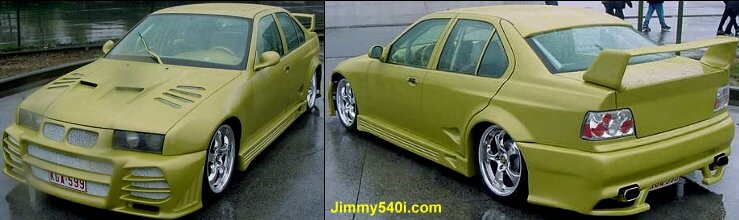
I think the point of this thread was slightly lost somewhere. But all is well because at the end of the day I'm not driving this:
-
slimdevil27
- Posts: 935
- Joined: Nov 12, 2011
- Location: WA
-
Night Wolf
- Posts: 226
- Joined: Sep 26, 2010
- Location: Middle GA
LOL @ OMGZ an e36 U CAN'T FIX DAT SHIT AT HOME!
.
That said I had a '92 318iC (e30) and the M42 is one spunky fun engine. Unfortunately it was BMW's test bed for many things and as such has many quirks. Point being though - if a given car/engine is nearing 20yrs old, highly doubtful it'll just quit tomorrow if maintained. I saw he no longer wants to trade. One thing is certain though - I will not do a rusty car again. Rust/rot triumphs over everything else in terms of a car being ''worth it''. Exactly the reason I bought and fixed up my e28, a car most others would have sent to the junk yard.
.
That said I had a '92 318iC (e30) and the M42 is one spunky fun engine. Unfortunately it was BMW's test bed for many things and as such has many quirks. Point being though - if a given car/engine is nearing 20yrs old, highly doubtful it'll just quit tomorrow if maintained. I saw he no longer wants to trade. One thing is certain though - I will not do a rusty car again. Rust/rot triumphs over everything else in terms of a car being ''worth it''. Exactly the reason I bought and fixed up my e28, a car most others would have sent to the junk yard.